
Cancer treatment has evolved significantly over the years, offering patients more personalized and effective options. Among the most commonly discussed treatments today are chemotherapy and immunotherapy. While both aim to fight cancer, they work in very different ways and are suited for different situations.
At a well-equipped cancer center in Khar, Mumbai, patients are guided through these treatment options with clarity and care, ensuring they understand what each therapy involves and how it can benefit their specific condition.
Understanding the difference between chemotherapy and immunotherapy can help patients make informed decisions about their treatment journey.
“Every patient who walks through our door deserves a treatment plan built around their specific cancer — not a one-size-fits-all approach. The choice between chemotherapy, immunotherapy, or a combination of both is one of the most important clinical decisions we make together.”
— Dr. Mohan Menon, Senior Consultant Medical Oncologist
What is Chemotherapy?
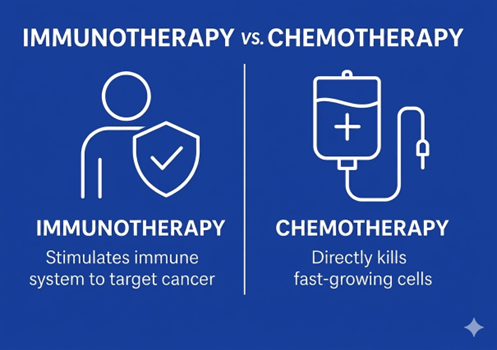
Chemotherapy is one of the most widely used cancer treatments. It involves the use of powerful drugs to destroy cancer cells.
These drugs work by targeting rapidly dividing cells, which is a key characteristic of cancer. However, they may also affect some healthy fast-growing cells in the body.
Chemotherapy is commonly used to:
- Shrink tumors
- Destroy cancer cells
- Prevent cancer from spreading
- Reduce the risk of recurrence
Key facts about chemotherapy
- It can be given intravenously (IV), orally, by injection, or as a combination of these.
- Chemotherapy works systemically — meaning it can reach cancer cells that have spread throughout the body.
- It is often given in cycles, with rest periods to allow the body to recover between sessions.
- It can be used as a standalone treatment or combined with surgery, radiation, or immunotherapy.
What is Immunotherapy?
Immunotherapy is a newer and more targeted form of cancer treatment. Instead of directly attacking cancer cells, it helps the body’s immune system recognize and fight cancer more effectively.
Cancer cells often find ways to hide from the immune system. Immunotherapy works by “activating” or “boosting” the immune response so that the body can identify and destroy these abnormal cells.
It is commonly used in cancers such as lung cancer, melanoma, and certain types of breast cancer, depending on specific biomarkers. While many patients explore whether immunotherapy can cure stage 4 cancer, the reality is that outcomes vary; some patients may experience long-term remission, while others may benefit from disease control and improved quality of life.
Key facts about immunotherapy
- Immunotherapy harnesses the body’s natural immune defenses rather than introducing external toxic agents.
- It has shown dramatic results in melanoma, non-small cell lung cancer, bladder cancer, and certain lymphomas.
- Some patients who respond to immunotherapy can achieve long-lasting remissions lasting years beyond treatment completion.
- Not all cancer types respond equally to immunotherapy — biomarker testing is often needed to determine suitability.
Confused about chemotherapy vs immunotherapy? Speak to an experienced oncology team to choose the right treatment for your condition.
Chemotherapy vs immunotherapy:
| Feature | Chemotherapy | Immunotherapy |
| How it works | Kills rapidly dividing cancer cells using chemical agents | Activates the immune system to detect and destroy cancer cells |
| Target | All rapidly dividing cells (cancer + some healthy cells) | Specifically cancer cells via immune recognition |
| Common side effects | Nausea, hair loss, fatigue, low blood counts, mouth sores | Fatigue, skin reactions, flu-like symptoms, rare inflammation of organs |
| Administration | IV infusion, oral, injection—often in cycles | IV infusion, typically every 2–6 weeks |
| Duration of response | Effective during active treatment, cancer may return | Can produce durable, long-lasting responses in some patients |
| Cancer types treated | Broad — most solid tumors and blood cancers | Highly effective in melanoma, lung, bladder, some blood cancers |
| Biomarker testing needed? | Sometimes, for targeted chemotherapy protocols | Often, yes, PDL-1, MSI, TMB testing help determine response |
| Cost | Lower for standard agents; higher for targeted combinations | Generally higher; can vary based on number of cycles required |
Can chemotherapy and immunotherapy be used together?

Absolutely and this combination is increasingly common in modern oncology. Combining both approaches can produce better outcomes than either treatment alone, particularly in lung cancer, bladder cancer, and certain head and neck cancers. Chemotherapy can help “prime” the immune environment of a tumor, making it more visible to immunotherapy drugs.
Get expert guidance for your cancer treatment journey—book a consultation and explore personalized care options today.
Which Treatment is Right for You?
There is no single “better” option. The right treatment depends on:
- Type and stage of cancer
- Genetic and molecular characteristics
- Patient’s overall health
- Treatment goals
Factors that guide the treatment decision
- Cancer type and specific subtype (e.g., squamous vs. adenocarcinoma in lung cancer)
- Stage of disease — early, locally advanced, or metastatic
- PDL-1 expression and other biomarker results
- Patient’s performance status and organ function
- Prior treatment history and response
- Patient goals: curative intent vs. quality-of-life focused care
Availability of clinical trials or newer treatment protocols
Why Expert Guidance Matters
Choosing the right cancer treatment is a critical decision. Modern oncology care focuses not just on treating cancer but also on:
- Personalizing treatment plans
- Managing side effects proactively
- Supporting patients throughout their journey
With the right guidance and support system, patients can approach treatment with greater confidence and clarity.
You Are Not Alone
A cancer diagnosis can feel overwhelming, but today’s advanced treatments offer more effective and manageable options than ever before. Understanding chemotherapy and immunotherapy helps you make informed decisions with confidence.
FAQs
1. Is immunotherapy better than chemotherapy?
Not necessarily. Each treatment works differently and is suitable for specific types of cancer. Your doctor will recommend what is best for your condition.
2. Does immunotherapy have fewer side effects?
It may have fewer traditional side effects than chemotherapy, but it can still cause immune-related reactions that require monitoring.
3. Can I receive both treatments together?
Yes, in many cases a combination approach is used to improve effectiveness.
4. How do doctors decide between the two?
The decision is based on cancer type, stage, biomarkers, and overall patient health.
5. Is chemotherapy still necessary today?
Yes. Chemotherapy remains one of the most effective and widely used cancer treatments worldwide.